Why EMDR Will Change the Way You Process Sexual Trauma

[HERO] Why EMDR Will Change the Way You Process Sexual Trauma

If you’re reading this, I want to name something first: it takes courage to be here.

If you’ve tried to “talk it through” and still feel flooded—tight throat, blank mind, tears that surprise you, a therapy “hangover” that lasts for days—there’s a reason. There’s no shame in that.

Sexual trauma isn’t just a story you remember. It can live in your nervous system. That’s why traditional, top-down talk therapy can hit a wall. Your survival brain can treat the conversation like danger and pull you into fight, flight, or freeze. (More on the trauma brain here.)

EMDR (Eye Movement Desensitization and Reprocessing) is an evidence-based trauma therapy that works bottom-up. You don’t have to share every detail out loud for your brain to process what got stuck.

What EMDR Is (in plain language)

EMDR uses bilateral stimulation (eye movements, taps, or tones) while you briefly focus on a memory—just enough for your brain to “touch” it without getting stuck in it.

Trauma can “freeze” a memory with the original body sensations, emotions, and meanings attached. During the reprocessing part of EMDR, your brain starts linking the stuck memory with more adaptive information—like context, safety, and what you know now—so it can finally be stored differently.

One way to think about it: EMDR helps move the memory from the emotional alarm system (often associated with the amygdala) to the thinking/meaning-making part of the brain (often associated with the prefrontal cortex). Instead of your body reacting like it’s a present threat, it starts to feel more like a story that happened back then.

You may still remember it, but it has less charge—and you get more choice in how you respond.

The shift: shame loosens

After sexual trauma, many people carry beliefs like:

  • “It was my fault.”
  • “I’m dirty.”
  • “I’m not safe.”

In EMDR, we don’t argue with these thoughts. We process what your nervous system learned in the moment. Over time, your brain often lands on something truer, like: “I did what I had to do to survive,” or “It wasn’t my fault.” There’s no shame in how long this takes.

You can learn more about my EMDR work here.

Triggers get quieter

EMDR also targets the body-level distress underneath triggers and flashbacks. The goal isn’t to erase your past. It’s to lower the alarm so your present life isn’t constantly interrupted by it.

Safety first (always)

We go at your pace. We start with resourcing—grounding, containment, and skills that help you stay within your window of tolerance. If your system says “slow down,” we listen. Your comfort is the priority.

The goal: lasting healing

EMDR isn’t a quick fix. But it is a direct path toward relief: fewer flashbacks, less shame, less reactivity, more choice.

If you’re curious whether EMDR is a fit, I invite you to reach out. We can talk about what you’re dealing with and what safety would need to look like for you.

Ready to Take the Next Step?

You don’t have to carry this alone. If you’re looking for mental health services that specialize in sexual trauma and use EMDR, I’m here.

I offer consultations so we can see if we’re a good fit. You can learn more about me here, or contact me here.

There is hope for a life that feels lighter, safer, and more yours.

Complex Trauma Therapy: 7 Things You Should Know About Your "Window of Tolerance"

[HERO] Complex Trauma Therapy: 7 Things You Should Know About Your

If you’ve lived through trauma, especially complex trauma or sexual abuse, you might feel like your internal thermostat is permanently broken. One minute, you’re buzzing with anxiety, your heart racing as if there’s a threat behind every door. The next, you’re completely checked out, feeling numb, heavy, and disconnected from the world around you.

It’s exhausting, isn’t it? To feel like you’re either “too much” or “not enough,” with very little space in between.

In the world of therapy, we have a name for that middle space where life feels manageable: the Window of Tolerance. For adult survivors of complex trauma, understanding this concept isn't just a clinical exercise; it’s a vital map for your healing journey. It helps explain why you react the way you do and, more importantly, it shows that your reactions aren’t "crazy", they are survival strategies your body learned a long time ago.

Let’s sit down together and look at seven things you should know about your Window of Tolerance and how we can work to expand it.


1. It’s Your "Optimal Arousal Zone"

Think of your Window of Tolerance as the “just right” zone for your nervous system. When you are inside this window, you can handle the ups and downs of life. You might feel sad, angry, or excited, but those emotions don't blow your fuse. You can still think clearly, communicate your needs, and stay present in the room.

In this zone, your brain’s “upstairs” (the rational, thinking part) and “downstairs” (the emotional, reactive part) are talking to each other. When we work together in complex trauma therapy, our goal isn't just to talk about what happened; it's to help you stay in this window long enough to actually process the feelings.

2. Being "In the Window" Doesn’t Mean You’re Calm

This is a big misconception. People often think that if they aren’t perfectly peaceful or "zen," they’ve failed. But being in your window doesn't mean you’re a robot. It just means you’re resilient.

You can be frustrated with your partner or stressed about a deadline and still be in your window. The difference is that you have access to your tools. You can take a breath, or realize you’re getting frustrated, and choose how to respond rather than just reacting from a place of survival. There’s no shame in feeling big emotions; the window is simply about whether you can stay “with” yourself while you feel them.

Filipino therapist and client in a warm office, practicing emotional regulation for complex trauma therapy.

3. Trauma Narrows Your Window

If you’ve experienced prolonged trauma, your nervous system had to become incredibly sensitive to stay safe. As a result, your window often shrinks. What might be a minor inconvenience to someone else, a loud noise, a specific tone of voice, or a crowded room, can feel like a full-blown emergency to your system.

When the window is narrow, you spend most of your time pushed outside of it. You might feel like you’re walking on eggshells with your own emotions. This narrowing is a direct result of how trauma impacts the brain. Your body is trying to protect you by being on high alert, even when the original danger is gone.

4. You Might Swing Between Hyperarousal and Hypoarousal

When you get pushed out of your window, you usually go in one of two directions:

  • Hyperarousal (The "Gas" Pedal): This is the fight-or-flight response. You feel anxious, panicky, angry, or hyper-vigilant. Your heart might race, and your thoughts might spin. It feels like you’re vibrating at a frequency that’s too high to sustain.
  • Hypoarousal (The "Brake" Pedal): This is the freeze or collapse response. You feel numb, empty, exhausted, or "spacey." It’s a form of dissociation where your body decides the best way to survive is to shut down and disappear.

For survivors of sexual trauma, the freeze response is incredibly common. If you’ve ever wondered why you "checked out" during a difficult moment, please know it was your body’s way of protecting you. It’s a biological survival mechanism, not a personal failing.

Hispanic therapist and Filipino client using grounding techniques to stay in the window of tolerance.

5. Stabilization Must Come Before Deep Processing

In my practice, I often see clients who want to dive straight into the hardest parts of their story. I understand that urge, you want the pain to be gone. But if we try to process heavy trauma while you are outside your window of tolerance, it can actually be re-traumatizing.

Healing requires a "titrated" approach, meaning we take it in small, manageable bites. We start by building your stabilization skills. We find gentle techniques to handle flashbacks and grounding tools that keep your feet on the floor. We ensure you have enough "room" in your window before we ask you to look at the hard stuff.

6. EMDR Can Help Expand the Window

One of the most effective tools I use for layered, complex trauma is EMDR (Eye Movement Desensitization and Reprocessing). EMDR doesn't just ask you to talk about what happened; it helps your brain re-process the traumatic memories so they no longer trigger that "emergency" response in your nervous system.

By using bilateral stimulation (like side-to-side eye movements), EMDR therapy helps "digest" the trauma. As those memories become less "spicy," your window of tolerance naturally begins to widen. You start to find that things that used to send you into a panic or a shutdown no longer have the same power over you. It’s like clearing a cluttered path so you can finally walk through it without tripping.

Asian therapist guiding a client through EMDR therapy to expand their window of tolerance and process trauma.

7. Widening the Window Takes Repetition, Not Just Insight

You can read every book on trauma (and many of my clients do!), but insight alone doesn’t change the nervous system. Healing happens through the body. It happens every time you notice you’re starting to drift toward a "shutdown" and you use a grounding tool to stay present. It happens every time you’re in a session with me and you feel safe enough to let a tear fall instead of numbing out.

It’s slow, iterative work. It’s about building a relationship with your body where it finally believes that the danger is over. This is why a safe, warm, and non-judgmental therapy environment is so crucial. You need a space where you can experiment with being "in your window" without fear of being criticized or rushed.


Finding Your Way Back to Yourself

I want you to know that if you feel like you’ve been living outside your window for years, there is hope. Your nervous system is incredibly plastic, it can learn to feel safe again. You aren't broken; you've just been in survival mode for a long time.

As a therapist, I see my role as a "co-regulator." In our sessions, whether we are meeting in person or through online trauma therapy across California, I am here to hold a steady space for you. We move at your pace. We honor your "no" as much as your "yes." We work together to slowly, gently stretch that window until you have the room to not just survive, but to actually live.

If you’re ready to start exploring your own window of tolerance and find tools that help you feel more at home in your own skin, I’d love to connect. You can learn more about my approach here, or reach out directly to schedule a time to chat.

Healing is possible. You don't have to navigate this alone.

Filipino therapist and Asian client sharing a moment of hope and healing after complex trauma therapy.

Warmly, Jana Rae Corpuz, LMFT

If you are looking for support, I offer in person and online therapy services for residents throughout California. Please feel free to contact me to see if we might be a good fit for your healing journey.

heroImage

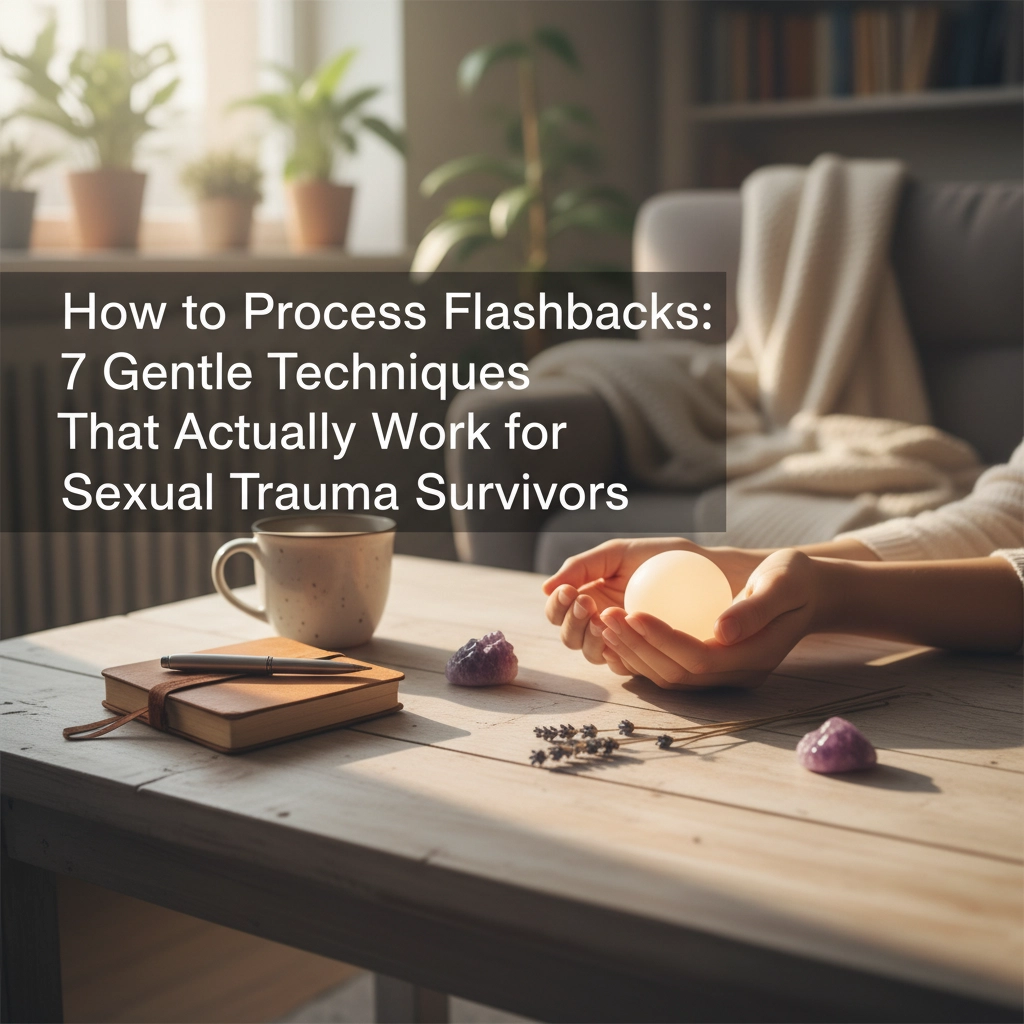
If you're reading this, chances are you've experienced a flashback: or you're supporting someone who has. First, let me say this: having flashbacks after sexual trauma is completely normal. Your brain is doing exactly what it was designed to do to keep you safe. There's no shame in that.

Flashbacks can feel overwhelming and scary, but they're actually your nervous system's way of processing something that was too much to handle at the time it happened. The good news is that there are gentle, evidence-based techniques that can help you feel more in control when they occur.

What's Really Happening During a Flashback

When you experience a flashback, your brain's alarm system (the limbic system) gets activated as if the trauma is happening right now. Your body doesn't know the difference between remembering something dangerous and being in actual danger. This is why flashbacks can feel so real and intense: your nervous system is genuinely trying to protect you.

Understanding this can help reduce some of the fear around flashbacks. You're not "losing it" or "going crazy." Your brain is working exactly as it should, given what you've been through.

Technique 1: Ground Yourself Through Your Five Senses

One of the most effective ways to interrupt a flashback is to anchor yourself in the present moment using your senses. This technique works because it helps your brain distinguish between the past trauma and your current safety.

Start with what you can see around you right now. Name five things you can see: maybe the color of the walls, a plant in the corner, or the texture of your clothing. Then move to four things you can touch, three things you can hear, two things you can smell, and one thing you can taste.

This isn't about forcing anything or making the flashback stop immediately. It's about gently reminding your nervous system where you actually are: safe, in the present moment.

image_1

Technique 2: Use Your Breath as an Anchor

When flashbacks hit, your breathing often becomes shallow and rapid. This sends more alarm signals to your brain. By consciously slowing and deepening your breath, you can help calm your nervous system.

Try this: breathe in slowly through your nose for a count of four, hold for a count of four, then exhale through your mouth for a count of six. The longer exhale is key: it activates your parasympathetic nervous system, which is responsible for the "rest and digest" response.

If counting feels too complicated during a flashback, that's okay. Just focus on making your exhale longer than your inhale. Even that small shift can make a difference.

Technique 3: Remind Yourself What's True Right Now

During a flashback, it can help to gently remind yourself of what's actually happening. This isn't about dismissing your experience: it's about helping your brain catch up to reality.

Try saying to yourself: "I'm having a flashback. This is a memory of something that already happened. I survived it then, and I'm safe right now." You might also remind yourself of basic facts about the present: "It's Monday. I'm in my living room. I'm 35 years old now."

Some people find it helpful to have these reminders written down on their phone or on a card they can reference. When you're in the middle of a flashback, it's hard to think clearly, so having these truths readily available can be incredibly grounding.

Technique 4: Find or Create Physical Safety

If possible, move to a space where you feel safe and secure. This might be your bedroom, a cozy corner of your living room, or even just stepping outside for fresh air. If you can't physically move, you can create a sense of safety by wrapping yourself in a blanket, holding a comforting object, or even just placing your back against a wall.

The goal isn't to hide from your feelings, but to create an environment where your nervous system can start to calm down. Sometimes having your back protected or being in a smaller space can help your body feel more secure.

image_2

Technique 5: Use Gentle Physical Grounding

Physical grounding techniques can help interrupt the flashback by giving your nervous system something concrete to focus on in the present moment. The key word here is gentle: you're not trying to shock yourself out of the flashback.

Try pressing your feet firmly into the ground, or gently tapping your hands on your thighs. Some people find it helpful to hold an ice cube or splash cool water on their face. Others prefer progressive muscle relaxation: gently tensing and then releasing different muscle groups.

Notice what feels good to your body right now. Trust your instincts about what feels comforting versus what feels overwhelming.

Technique 6: Reconnect With Safe Parts of Your Body

Trauma can create a disconnection from your body, but part of healing involves slowly and safely reconnecting with physical sensations that feel okay. This technique is about identifying parts of your body that feel safe or neutral to focus on.

Maybe it's your hands, your feet, or your shoulders. Gently place your attention there. Notice the sensations without judgment: warmth, coolness, tension, or relaxation. If you're comfortable, you might gently touch or massage these areas.

This isn't about forcing anything or pushing through discomfort. If focusing on your body feels overwhelming, that's completely normal. Come back to your breath or your five senses instead.

image_3

Technique 7: Reach Out for Support

Having flashbacks can feel isolating, but you don't have to go through this alone. When you're ready, consider reaching out to someone in your support system: a trusted friend, family member, or counselor who understands trauma.

Sometimes just hearing a familiar, caring voice can help remind your nervous system that you're safe. You don't have to explain everything that's happening; sometimes just saying "I'm having a difficult moment and could use some support" is enough.

If you don't have someone to call, consider joining an online support group for trauma survivors or contacting a crisis support line. Many people find comfort in knowing that others have walked this path and found healing.

Moving Forward With Compassion

Remember, healing from sexual trauma isn't linear. Some days will be harder than others, and that's okay. Flashbacks might feel scary, but they're actually a sign that your nervous system is trying to process and heal from what happened to you.

These techniques aren't about making flashbacks disappear forever: they're about helping you feel more equipped to handle them when they do occur. With practice, many people find that flashbacks become less intense and less frequent over time.

If you're finding that flashbacks are significantly impacting your daily life, working with a trauma-informed therapist can provide additional support and healing tools. EMDR therapy and other trauma-focused approaches can be particularly helpful for processing traumatic memories in a safe, controlled way.

You deserve support, healing, and peace. These techniques are one piece of your healing journey, and every small step you take toward caring for yourself matters more than you know.